Pages

Tuesday, April 9, 2013

Energy from within


In this week, dedicated to holocaust remembrance, Yom Hashoah, I am acutely aware of both my freedom and my good fortune.

I am also reflecting on the power and necessity of inner strength and confidence; because although it is wonderful to find energy from outside forces, it is most powerful and sustainable to find that energy within myself.

The victims and survivors of the Holocaust are a true testament of this ability to sustain oneself from forces within. They found the courage and strength to believe in themselves and their own self-worth. Some even found the courage to fight back, as in the Warsaw Ghetto Uprising, which marks its 70th anniversary this year.

* *

I am nearing the end of one of the best weeks of my life. It was filled with so many inspiring events and experiences that have given me an intense amount of energy. I am so grateful for these blessings; however I am also reflecting on how to sustain this level of confidence and strength beyond this week.

It started last Tuesday with the Mimouna; the magical and glorious Moroccan Jewish celebration that marks the end of Passover with platters of delicious carb-filled delicacies. With an open door policy throughout the community, I hopped around with friends and family, finding more hospitality and deliciousness with every home we visited.

On Wednesday, I was invited to speak at a leadership conference organized by the Garnet Key Society of Concordia University in Montreal. I spoke about how my parents and grandparents, themselves holocaust survivors, have informed and inspired my academic and professional career, as well as my ongoing commitment to social justice. This influence has expressed itself through three key pillars that have supported me through the years. These include: 1) Learn a skill – in any and every class, job, or experience, I think about what can I get out of the situation to add to my toolbox, and focus on enhancing that skill; 2) Be brave – opportunities are abound, but you need to take risks and seize them as they come; 3) Leave a place better than you found it – you will always gain more if you invest in the community, people and place around you. 


I was so touched by the students’ response to my talk, and their genuine passion and engagement for their own work and ambitions. I never felt so honored and respected; it made me realize how far I’ve really come since I was in their shoes as an undergraduate student at McGill.

On Thursday, I was in the depths of organizing a conference, running around like a chicken without a head. Amidst the frenzy, I received a call. It was someone from the office of the ROI Community inviting me to attend this year’s ROI summit in Jerusalem, Israel. The ROI summit brings together young Jewish innovators each year for four days in Jerusalem. People come from around the world; from Brisbane to Belarus, Boston to Brazil. I first participated in the summit in 2008. As I could barely contain my excitement, the woman over the phone expressed that I was selected among hundreds of alumni to return as one of the thirty representatives from past summits. She explained how the ROI leadership had recently seen me in action at NU Montreal, a conference for young Jewish innovators working in New Media, and felt that I would be a great addition to the team.


Then the day I have been working towards all year finally arrived. I am launching a web startup this spring called Trudat; a platform for collaborative data discovery. My co-founder and I organized a conference - the Open Data Exchange 2013 - at Maison Jeanne Sauvé this past Saturday. The conference was for researchers, advocates, techies, politicos, and friends involved and interested in Open Data movement for liberating data sets to improve transparency, civic engagement, and innovation in government, research, and beyond.  


ODX13 was a beautiful symphony of brilliant minds and engaged souls. And although I was one of the conductors behind the orchestra, it was the performers and audience who really made the magic. At the end of the day, I felt on top of the world from all the positive energy they were sending my way.

Today I turn 29 years old; the culmination of a wonderful week, as well as a charmed life. I feel so energized from this past week’s events, filled with positive affirmation from others for my life choices and performance. However, this year has also been filled with many many moments of self doubt. My wish for my 29th birthday is to harness this positive energy to find it within myself to always believe in my own self-worth. Encouragement is always welcome and needed, and I feel so fortunate to have so many supporting forces in my life; but I strive to find those voices within myself. I strive to believe in my infinite talent and potential and to continue to inspire the same in others.


Monday, April 8, 2013

How to counteract hate speech online?

I spent the last few days in Europe – Budapest, Hungary to attend a meeting of the Advisory Council on Youth of the Council of Europe. It is a body composed of 30 representatives of youth NGOs (Non-Governmental Organizations). It provides opinions and input on all issues concerning youth within the Council of Europe. The Advisory Council ensures also that young people are involved and their voices are heard in the institution’s broader activities. 

One of the main topics discussed was a recently launched campaign: No Hate Speech Campaign, which was launched on the 22nd March by the Secretary General of the Council of Europe. The campaign and the ‘No Hate Speech Movement’, which accompanies the campaign, were born out of the realization that young people are exposed to violence, discrimination, and bullying online. The space that was once supposed to be the safe haven for all became a space where hate, prejudice, and stigma started to rule hurting the most vulnerable.

No Hate Speech Campaign has a few very important objectives:
•                To raise awareness about hate speech online and its risks for democracy and for individual
young people
•                To promote media and Internet literacy
•                To support young people in standing up for human rights, online and offline
•                To reduce the levels of acceptance of online hate speech
•                To mobilize, train and network online youth activists for human rights
•                To map hate speech online and develop tools for constructive responses
•                To support and show solidarity to people and groups targeted by hate speech online
•                To advocate for consensus on European policy instruments combating hate speech
•                To develop youth participation and citizenship online

The Campaign is promoted by a video presenting the topic of hate speech online where a few young people from different places in Europe talk about what hate speech online means to them and how it affect young people. Here you can see the video. I am very proud of it as one of the people present there is from my organization, ANSO (Association of Nordic and Pol-Balt LGBTQ Student Organizations). I think also that it is powerful and touches upon several topics present in Europe nowadays. 

The Campaign has many elements from training courses for bloggers, to research, various tools, to the Hate Speech Watch. It is an interesting approach to bullying or discrimination as it seems like those happening digitally have not been looked at with the same concern as the ones happening ‘in the real life’.
I am very curious how the campaign will develop especially that it is not supposed to be only European level campaign. It is supposed to be driven on national levels as well and not only online but offline, too. It will be definitely interesting to see it grow. So far there are national committees being set up in 34 member states of the Council of Europe (out of 47), which is a great number already. I really hope that the topic of hate speech and online bullying will get on agenda in Europe, not only within activists or NGOs circles but also in schools!

We could be witnessing a real change in attitudes and approaches to using Internet.
To read more about the campaign and No Hate Speech Movement, please go to the official website. And...join the movement! Share what YOU are doing to counteract hate speech online!

Free Health Care is a Privilege

A visit to emergency room in Montreal

I have a reputation of going to ER in every country that I have lived in –Canada could not be an exception. When I had an episode last month, some of my friends scared me of Canadian healthcare. Having lived in the US for many years, and being a loyal visitor to emergency rooms, I was horrified and tried everything possible to bypass the ER and visit a specialist directly. I was told that the ER in Canada is worse than in the US. Waiting time is never ending, and the waiting period for tests can be months. However, an important piece of information that was not promoted is the fact that the healthcare is absolutely free.

Anyway, with all negative thoughts I went to ER. To my surprise, I got to see the doctor within two hours. All the required tests were done in less than three hours. Once it was established that I was not in a life-threatening situation, I had to wait little bit longer to see a specialist.

If it took longer for me to see a specialist because the other patients needed the immediate care, I would never mind that. Especially, when I don’t have to care about my medical bills, or be worried about if my insurance company is going to cover my expenses.

In Canada, when you go to ER, you are worried about your health. But when you go to ER in the US, besides your health concerns, it is medical bills and insurance coverage that adds to your miseries.

Free healthcare is a privilege that people should highly value.

Monday, March 25, 2013

Senegal National Dinner at Sauve House

This is a short video clip from Senegalese cultural night:

Tuesday, March 12, 2013

Maternal Health in Nigeria


As the 2015 deadline for the Millennium Development Goals (MDG) draws near, the debate has intensified in many quarters about the issue of countries that may not meet some of the goals. Unfortunately, Nigeria features very high on the list of such countries because it is unlikely to meet the MDG’s related to maternal mortality –“Promoting gender equality and improving maternal health”. As a Nigerian doctor, I am appalled by statistics that indicate that Nigeria  is responsible for about 14 percent of global maternal deaths. The inability of the Nigerian healthcare sector to rise to its challenges and its persistent failure have made people – particularly women pay a very heavy price.  The lack of access to  quality and affordable health care, the  menace of  untrained traditional birth attendants, obnoxious cultural and religious practices which rob women of healthcare decision making powers, have all contributed  to the rise in maternal mortality in Nigeria. Almost every week, I see or hear about women of various ages and backgrounds who walk in to the hospital to have their babies and are driven out in hearses. In spite of the seemingly bleak picture, I am consoled by the fact that in the Chinese language the term crisis and opportunity are represented by the same word. In that view, Nigeria’s crisis therefore represents its deployable idle capacities to challenge maternal mortality. What must be done for Nigeria to harness its idle capacities and turn it into a success story? How can the double headed monster of ignorance on the part of the women and negligence on the part of the government be fought?      
                                                            
There must be a conscious, well thought out and articulated decision by the government to improve the parlous state of healthcare. The Government must realize that reductions in maternal mortality would not just happen. The strategies to reducing it have to be well planned and implemented by good leaders with good governance structures. The lack of foresight and the pursuit of wrong policy choices over the years is responsible for the state of Nigerian healthcare today. Politicians and policy makers must understand that good health is one of the major conditions for any form of economic growth or national development to occur and an important reason why some countries develop faster than others is that their citizens enjoy better health. Government policy should also be directed towards improving the social determinants of healthcare i.e the conditions in which Nigerians are born, grow, live, and work.

This is because the social determinants of health are mostly responsible for health inequities and these inequities have persisted and widened considerably over the years.                         
As part of the efforts to improve the health system of Nigeria, government health care policy should be geared towards primary healthcare as opposed to the current situation where about 70% of the health budget goes to hospitals and tertiary care centers. The importance of Primary Health Centre becomes evident in the context that Primary Health Centre services maybe the only service accessible to 60% of Nigerians living in rural areas. The poor are also less likely to visit hospitals and more likely to go to Primary Health Centre facilities to obtain medical treatment since they are cheaper. Additionally, women also need to get educated, informed and have their minds disabused  about  certain beliefs and practices concerning pregnancy and childbirth.

In conclusion, the challenge therefore to Nigerians today is that we need to get informed, educated and proactive about maternal mortality. We all need to tackle maternal mortality in whatever  way we can and in whatever situation we find ourselves. It is only when we do this that our country can begin a realistic march towards achieving the Millennium Development Goals  and achieving significant reductions in maternal mortality.

Friday, February 22, 2013

My First Winter Sports Experience!!!


My First Winter Sports Experience

I looked forward excitedly to the visit to Nancy Wright’s cottage in the Laurentians for weeks. It was going to be my first winter sports experience.  However, the week leading up was the coldest week of my life (I am not exaggerating!!!) with temperatures averaging -25 degrees celsius  and so by the Thursday before, my excitement had turned to apprehension about what the weather conditions in the mountains might be.

Spending a whole weekend outdoors was not looking good. Good or bad weather, I was off on Friday evening.  I hopped into the car and we drove about two hours north of Montreal to Entrelacs, chatting as we went about everything from sports to living abroad, to our career plans post the Sauvé year.


After unloading our luggage, and eating a wonderful meal, the other scholars and I went  to the top of a slope near Nancy’s beautiful winter
house. There, we started tobogganing on a perfect winter’s night under a full moon.

We got into the toboggan in pairs and tried to start the descent…it was 
disastrous! We sat, stuck not moving down the hill. Luckily, we had Brett, Simone, Jonathan, Valerie, and Naomi to help us "newbies" navigate the process after which it became much easier.

In a short while, we discovered that Guy had the best pushing effort and so we all began to  wait for Guy, the "super pusher" to push us down the slope.

Barreling down the slope in the sleigh — it was such a thrilling experience.

On Saturday morning, we had a leisurely drive from Nancy’s cottage to the majestic winter home of her friend’s Annie and Arnie.  Unlike many other people in the area who just spend the weekends in the mountains, Annie and Arnie make their life on a beautiful lake atop a mountain.  Annie and Arnie were very warm and nice and shared interesting stories from their experiences with previous scholars.

My first challenge of the day was learning to wear my snowshoes properly before our hike around the beautiful wooded area and across the frozen lake that lie on their property.

Let’s just say it took a few minutes to get adjusted to my new pair of very 

long and fancy plastic shoes.  I finally had to get some help from my friends to fasten them on.  It was not easy learning how to walk and turn with so much snow.  I kept falling and "eating" snow.

Snowshoeing on a frozen lake was a surreal experience for me. I checked the lake multiple times to ensure that it was really frozen. I  was literally "walking on water". From the lake, we took an enjoyable hike to the mountain top and came down through another route. We thereafter had a very nice lunch with hearty soups.

Sunday morning brought home the saying "saving the best for last.”

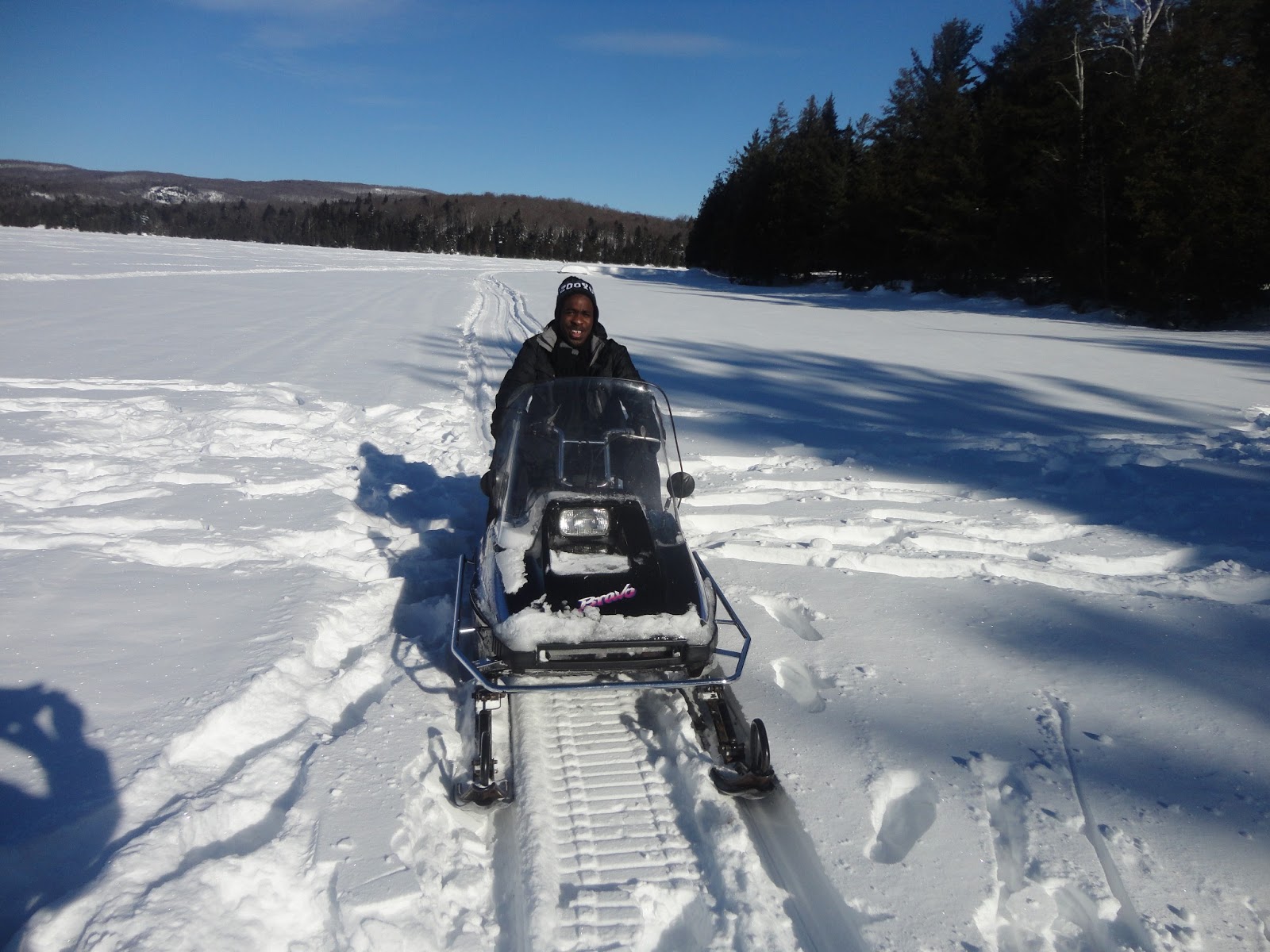
Nancy’s good friend had promised to bring his snow mobile. By 11 am, I was out waiting for him on yet another frozen lake behind Nancy s house. I learnt how to operate it and then excitedly put on my helmet, and zoomed off at top speed, navigating the turns, standing  on the snow mobile and trying out different stunts. Mame, Gerald and Guy also took turns riding the snowmobile and the four of us formed "The African Ski Team"!

A funny highlight for all of us was Guy falling off the snowmobile in his failed attempt to perform a stunt. It was so exhilarating.

It was also really nice watching Brett, Thinh and Tairah skiiing on the  frozen lake as well. I wanted to try out skiing but could not pull myself away from the snowmobile.  

After about two hours of driving the snowmobile, it was time to go back to Montreal. I ended up having so much fun that I secretly wished I could have stayed a bit longer.  As someone from Nigeria, where average temperatures are about 30 degrees all year round, I am glad to say that I have fallen in love completely with winter sports.

I can’t wait to go on another winter sports weekend again!


Thursday, February 21, 2013

Surviving Canadian Winter: A Sauvé Story


by Handy Acosta Cuellar


Half of the Sauvé Scholars Program has passed, and we, the scholars, are beginning to feel that the end is near.  That awareness has led me to reflect on the winter and year that has been thus far and to offer some advice.

The main entrance of the Sauvé House in winter
Though the white snow covers almost all of Montreal, we are experiencing crazy temperature variations — clear evidence of global warming.  But the cold days are still a factor, both in the streets of the city and in Sauvé House as well.  To avoid the cold temperature the scholars usually gather on the 3rd floor to work at night and talk about politics, news or even the program itself.  It’s a really enjoyable moment to learn from my partner’s perspectives and culture as well as to reflect on the program itself.

Before coming to Canada, many people warned me about the winter season, especially coming from Cuba a lovely tropical island.  It is the opinion of most all my Cuban friends that I probably will not survive my first winter and after the first snowstorm I will escape back to the island.

The truth: it is not that bad. 

In fact, you can enjoy the winter season. All you need to do is embrace the outside and try to do the same that Canadians do. That includes skating, skiing (cross country and alpine), snowball fights or just walking in the snow.  So my advice to you is not remain at home, but rather to take the initiative, explore and enjoy some outdoor activities.


Fist day skiing at Orangeville, Ontario. 
During this winter I had the chance to visit other provinces. I traveled to Nova Scotia and Ontario by train. It was an amazing experience that I strongly recommend. During the winter the Canadian landscape is totally gorgeous and the whiteness of the trails gives you an entirely different perspective of the geography.  I stayed almost 2 weeks with friends and host families, spending Christmas and New Years eve together with them. During my journey from the wild coast of Halifax to the mountains near Orangeville, I realized that Canadians are an incredible people.  Each person I met was open, warm, friendly and very welcoming.  Just by chatting I learned about diverse topics, from sustainable agriculture to zen meditation, from cross country skiing to soccer, and much more. 

Which leads to my second piece of advice: make friends and travel beyond Québec.


Field trip with colleagues from Dalhousie University in Cristal Crescent Park, Nova Scotia
Quebec, of course, also has much to offer.

Don’t suppose that everything is calm at Sauvé house.  The hokey season has started and my friend Jonathan has become crazy about it. If fact he organized a cultural night and managed to get most scholars into the Canadian passion for this game.  Now I am a fan of the Canadiens, the Habs as they are called, the local team and by far the best of the league.


Learning urban agriculture and composting in Montreal. 
Some final observations from this post are living, experiential statements about how “old man winter” can affect our brains. We learned how to compost our waste in the middle of the frozen park across the street thanks to Sauvé House staff Valerie, and Eco-Quartier McGill representative, Peter.   Even in the depths of the frigid cold, we have taken our first steps towards making the Sauvé House greener.


Yet another reason to love and enjoy the winter.